Burn Rate and Runway in AED and SAR: A Founder's Guide
How to calculate gross burn, net burn and runway for a UAE or Saudi startup, with worked examples in dirhams and riyals, the Gulf costs founders forget, and a table showing what each cut or extra sale does to your runway.
The short answer
Gross burn is the cash you spend each month. Net burn is cash out minus cash in. Runway = cash in the bank ÷ net burn. A Dubai startup with AED 1,100,000 in the bank, AED 150,000 going out and AED 40,000 coming in each month has a net burn of AED 110,000 and 10 months of runway. Use a three-month average, and count cash, not invoices.
Key takeaways
- Runway uses net burn; gross burn tells you the worst case.
- Average the last three months so one big payment doesn't distort the number.
- Spread yearly Gulf costs (licence, visas, insurance) into the monthly figure.
- Small changes compound: cutting AED 15,000 of cost and adding AED 30,000 of revenue turns 10 months into almost 17.
- Try your own numbers in the startup runway calculator.
What is the difference between gross burn and net burn?
Gross burn
- All cash out in a month
- Salaries, rent, software, suppliers, taxes
- Shows how long you'd last with no revenue
Net burn
- Cash out minus cash in
- What your bank balance actually loses each month
- The number to use for runway
Investors usually ask for both. Gross burn shows how much the team costs to run; net burn shows how quickly the money in the bank is disappearing once customers pay.
How do you calculate burn rate and runway step by step?
- 1
Take the last three full months
Use bank statements, not your profit and loss statement. Profit counts invoices and depreciation; burn counts cash.
- 2
Total the cash out for each month
Every payment from your business accounts, including VAT paid to suppliers and to the tax authority. Leave out transfers between your own accounts.
- 3
Total the cash in for each month
Customer payments and other income you actually received. Leave out new investment, because it isn't operating cash.
- 4
Average the three months
Gross burn = average cash out. Net burn = average (cash out − cash in).
- 5
Divide your cash by net burn
Runway in months = cash in the bank today ÷ net burn.
Worked example in AED
| August | September | October | Average | |
|---|---|---|---|---|
| Cash out | AED 142,000 | AED 151,000 | AED 157,000 | AED 150,000 (gross burn) |
| Cash in | AED 35,000 | AED 41,000 | AED 44,000 | AED 40,000 |
| Net burn | AED 107,000 | AED 110,000 | AED 113,000 | AED 110,000 |
With AED 1,100,000 in the bank, runway is 1,100,000 ÷ 110,000 = 10 months. On gross burn alone it would be 1,100,000 ÷ 150,000 = 7.3 months, which is the worst case if revenue stopped.
Worked example in SAR
A Riyadh e-commerce startup
Cash in the bank: SAR 3,000,000. Average cash out: SAR 320,000 a month. Average cash in: SAR 95,000 a month. Net burn = 320,000 − 95,000 = SAR 225,000. Runway = 3,000,000 ÷ 225,000 = 13.3 months.
What does each change do to your runway?
Runway responds to both sides of the equation. This table uses the Dubai example above: AED 1,100,000 in the bank.
| Scenario | Cash out | Cash in | Net burn | Runway |
|---|---|---|---|---|
| Today | AED 150,000 | AED 40,000 | AED 110,000 | 10.0 months |
| Cut costs 10% | AED 135,000 | AED 40,000 | AED 95,000 | 11.6 months |
| Add AED 30,000 of revenue | AED 150,000 | AED 70,000 | AED 80,000 | 13.8 months |
| Both | AED 135,000 | AED 70,000 | AED 65,000 | 16.9 months |
| Hire two people (AED 40,000) | AED 190,000 | AED 40,000 | AED 150,000 | 7.3 months |
Run it with growth
These rows assume nothing else changes. If your revenue is growing every month, add the growth rate in the runway calculator to see whether you reach break-even before the cash runs out.
Which Gulf costs do founders forget?
Make sure your burn includes
- Trade-licence renewal, spread over 12 months
- Visa and Emirates ID costs for each hire
- Medical insurance premiums
- VAT paid to the FTA or ZATCA each quarter
- End-of-service gratuity for UAE staff
- GOSI contributions for staff in Saudi Arabia
- Audit and tax-agent fees
- Annual zakat or income tax payments in Saudi Arabia
Most of these are paid once or a few times a year, so a single month's bank statement can make burn look lower than it is. Spread each one across the months it covers.
Is burn multiple better than runway?
They answer different questions. Runway tells you how long you have; burn multiple tells you how efficiently you're spending. It's net burn divided by net new annual recurring revenue (ARR) over the same period, a measure popularised by investor David Sacks.
Example
Over a quarter, net burn is AED 330,000 and ARR grows by AED 220,000. Burn multiple = 330,000 ÷ 220,000 = 1.5: you spend AED 1.50 to add each AED 1 of ARR. A common rule of thumb treats under 1 as excellent, 1 to 2 as good, and above 3 as a warning sign.
How much runway should a Gulf startup keep?
Raising a round often takes three to six months, so start the process while you still have at least nine to twelve months left.
How can you track burn and runway without a spreadsheet?
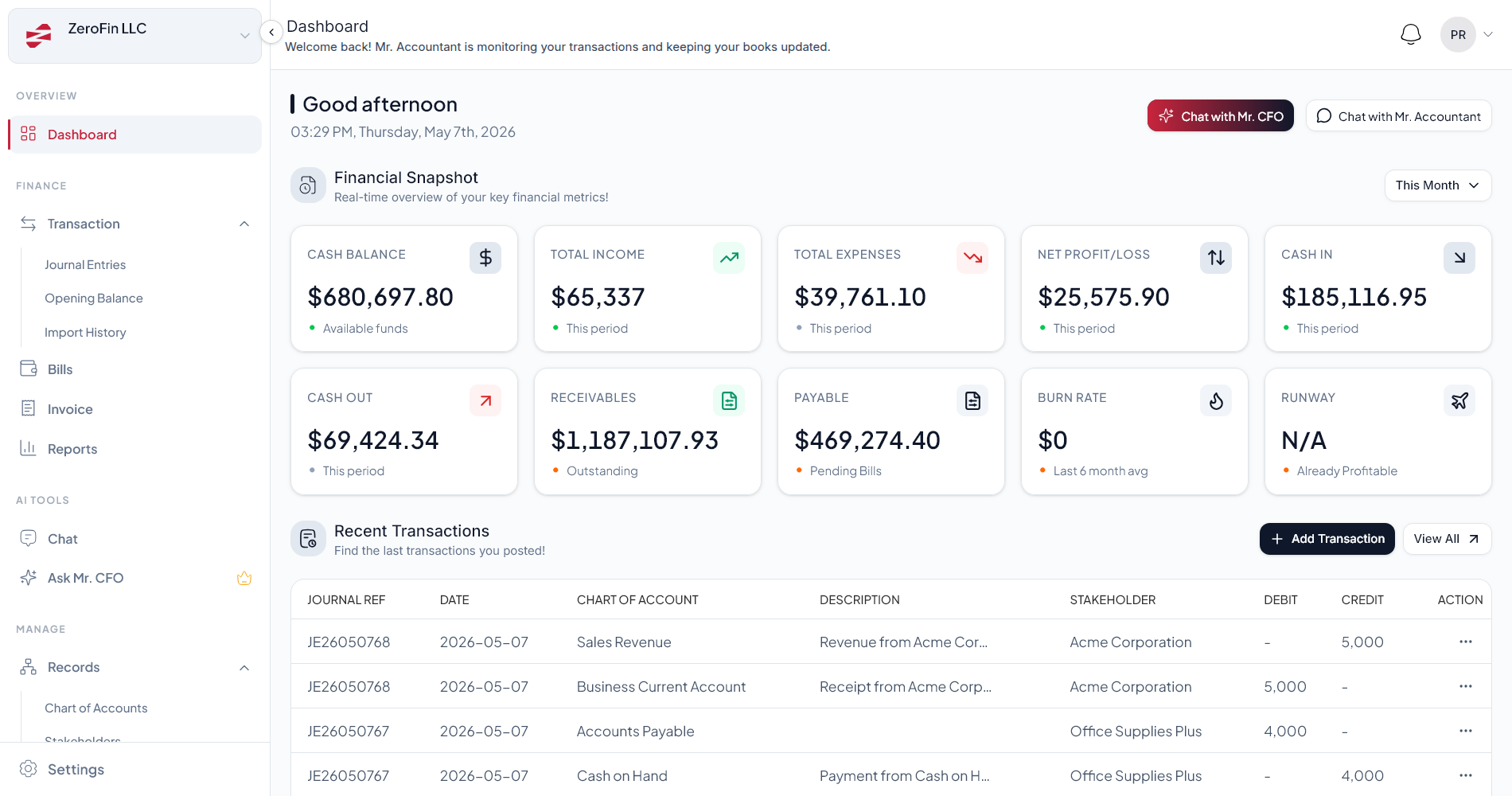
The numbers above are only as good as your books. In ZeroFin, the dashboard shows your burn rate as a six-month average and your runway, calculated from your own ledger, and you can keep the books in AED or SAR. ZeroFin Mr. CFO, the AI CFO inside ZeroFin, answers questions such as “What's our runway?” or “What were our top expenses last month?” from the same ledger. The Lite plan is $8 a month (about AED 29 or SAR 30, billed in US dollars) with 10 Mr. CFO questions a month; Growth, at $25, adds 100 questions plus daily briefings and weekly and monthly reports by email.
Mr. CFO reports what has happened in your books; it doesn't build forecasts or what-if scenarios. For “what if we hire two people?”, use the calculator. For more on reading the numbers, see cash balance vs runway and AI CFO software for UAE startups.
Frequently asked questions
What is burn rate?
Burn rate is how much cash a company spends each month. Gross burn is total cash out; net burn is cash out minus cash in. Runway is the cash in the bank divided by net burn.
How do I calculate net burn in AED or SAR?
Add up the cash that left your business bank accounts in each of the last three months, subtract the cash that came in, and average the three results. For example, AED 450,000 out and AED 120,000 in over three months is a net burn of AED 110,000 a month.
Does the currency change how runway is calculated?
No. The formula is the same in any currency. The UAE dirham and the Saudi riyal are both pegged to the US dollar, at about 3.6725 AED and 3.75 SAR per dollar, so costs you pay in dollars convert at a stable rate.
Which Gulf costs do founders forget in their burn rate?
Yearly costs such as trade-licence renewals, visas, medical insurance and audit fees; quarterly VAT payments; end-of-service gratuity for UAE staff; and GOSI social insurance contributions for staff in Saudi Arabia.
What is a good burn multiple?
Burn multiple is net burn divided by net new annual recurring revenue over the same period. A commonly used benchmark treats under 1 as excellent, 1 to 2 as good, and above 3 as a warning sign.
From messy books to CFO-level clarity
Book a free 20-minute Financial Clarity Diagnosis and see what trusted books look like for your business.
Book a Financial Clarity Diagnosis