How to Prepare Your Books for UAE Corporate Tax: A Checklist for Startups and SMEs
What UAE Corporate Tax expects from your books: the 9-month filing deadline, the 7-year record rule, which accounting standard you can use, when you need an audit, and how Small Business Relief now runs to 2029. With a step-by-step checklist.
The short answer
To be ready for UAE Corporate Tax, you need complete books for every tax period: a ledger that matches your bank statements, financial statements under an accepted standard (cash basis up to AED 3m revenue, IFRS for SMEs up to AED 50m, otherwise IFRS), and the records behind every figure, kept for 7 years. The return and any tax are due within 9 months of your year-end: 30 September for a December year-end. Small Business Relief still requires all of this.
Key takeaways
- Rates: 0% on taxable income up to AED 375,000, 9% above it.
- File and pay within 9 months of each period end, even if you owe nothing.
- Keep records for 7 years after the period end.
- Small Business Relief (revenue of AED 3m or less) now runs to tax periods ending 31 December 2029, but you must still register, file and keep records.
- Audited financial statements are required above AED 50m revenue and for every Qualifying Free Zone Person.
Which Corporate Tax rules affect your bookkeeping?
Most of what UAE Corporate Tax asks of a small business is about records, not rates. These are the rules that decide what your books must contain and when they must be ready.
| Rule | What it says | Source |
|---|---|---|
| Tax rate | 0% up to AED 375,000 of taxable income; 9% above | u.ae |
| Return and payment | Within 9 months of the end of the tax period | CT Law Arts 48 and 53 |
| Record keeping | 7 years after the end of the tax period | CT Law Art 56 |
| Cash basis | Allowed if revenue does not exceed AED 3 million | MD 114/2023 Art 2 |
| IFRS for SMEs | Allowed if revenue does not exceed AED 50 million | MD 114/2023 Art 4 |
| Audited statements | Revenue above AED 50 million, and every Qualifying Free Zone Person (periods starting on or after 1 January 2025) | MD 84/2025 |
| Small Business Relief | Revenue of AED 3 million or less, for tax periods ending on or before 31 December 2029 | MD 131/2026 |
Do you still need to file if you claim Small Business Relief?
Yes. Small Business Relief (SBR) lets a resident business with revenue of AED 3 million or less in the current and every previous tax period be treated as having no taxable income. On 29 July 2026, Ministerial Decision 131 of 2026 extended it to tax periods that end on or before 31 December 2029; it previously stopped at 2026, and some older guidance still shows that date. The Ministry of Finance announced the extension on 7 August 2026.
The relief changes the tax, not the paperwork. The FTA confirmed in August 2026 that businesses claiming it must still register, file a return within the deadline, elect SBR in that return, and be able to prove their revenue stayed under the threshold for every period. Electing SBR lets you file a simplified return.
Who can't use Small Business Relief
Qualifying Free Zone Persons and members of large multinational groups can't elect it. Tax losses from a year in which you claim SBR can't be carried forward, and splitting a business to stay under AED 3 million is treated as tax avoidance (Ministerial Decision 73 of 2023).
Which accounting standard can your business use?
| Your revenue | Standard you may use | What it means for your books |
|---|---|---|
| Up to AED 3 million | Cash basis (or IFRS for SMEs, or IFRS) | Income and costs recorded when cash moves; still a full record of every transaction |
| Up to AED 50 million | IFRS for SMEs (or IFRS) | Accrual accounting: invoices, bills, prepayments, accruals and depreciation |
| Above AED 50 million | IFRS | Full IFRS financial statements, audited |
Cash basis is simpler, but it isn't “no bookkeeping”. You still need every receipt and payment recorded and matched to your bank statements, because those records are what the FTA can ask to see.
Do you need audited financial statements?
For tax periods starting on or after 1 January 2025, Ministerial Decision 84 of 2025 requires audited financial statements from businesses with revenue above AED 50 million and from every Qualifying Free Zone Person, whatever its size. Your free zone authority or the companies law may require an audit as well, so check your licence conditions. An auditor will want a clean general ledger, reconciled bank accounts and the documents behind each figure, which is what the checklist below produces.
When must you register and file?
- 1
Register
Under FTA Decision 3 of 2024, a company incorporated in the UAE on or after 1 March 2024 generally has three months to register for Corporate Tax (summary). Registering late carries a penalty of AED 10,000 (Cabinet Decision 75 of 2023).
- 2
Close your financial year
Your tax period normally follows your financial year. Bring the books up to date and close the year as soon as it ends, not in month 8.
- 3
File and pay within 9 months
For a 31 December 2026 year-end, the return and any tax are due by 30 September 2027. A late return costs AED 500 a month for the first 12 months, then AED 1,000 a month.
The checklist: getting your books ready
- 1
Confirm your tax period and year-end
Check the financial year on your trade licence or articles, and the first tax period the FTA gave you at registration.
- 2
Collect every source document
Bank and card statements for every account, sales invoices, supplier bills, receipts, payroll records, loan and lease agreements, and any old spreadsheets or accounting exports.
- 3
Record every month of the period
Enter or import every transaction for every month, including the months you fell behind on. Gaps are what turn a simple return into a problem.
- 4
Match each bank account to its statements
For every month-end, the balance in your books should equal the closing balance on the bank statement. Investigate any difference before you move on.
- 5
Separate business and personal spending
Owner withdrawals and personal costs paid from the business account aren't business expenses. Record them as drawings or loans to the owner.
- 6
Flag costs the tax rules treat differently
Only 50% of client entertainment is deductible, and fines, penalties, bribes and owner dividends aren't deductible at all (CT Law Arts 32 and 33). Tag these in your ledger so your tax agent can adjust for them.
- 7
Record dealings with related parties
Keep a list of payments to owners, family members and companies you control or that control you. The tax rules look at these separately.
- 8
Produce the financial statements
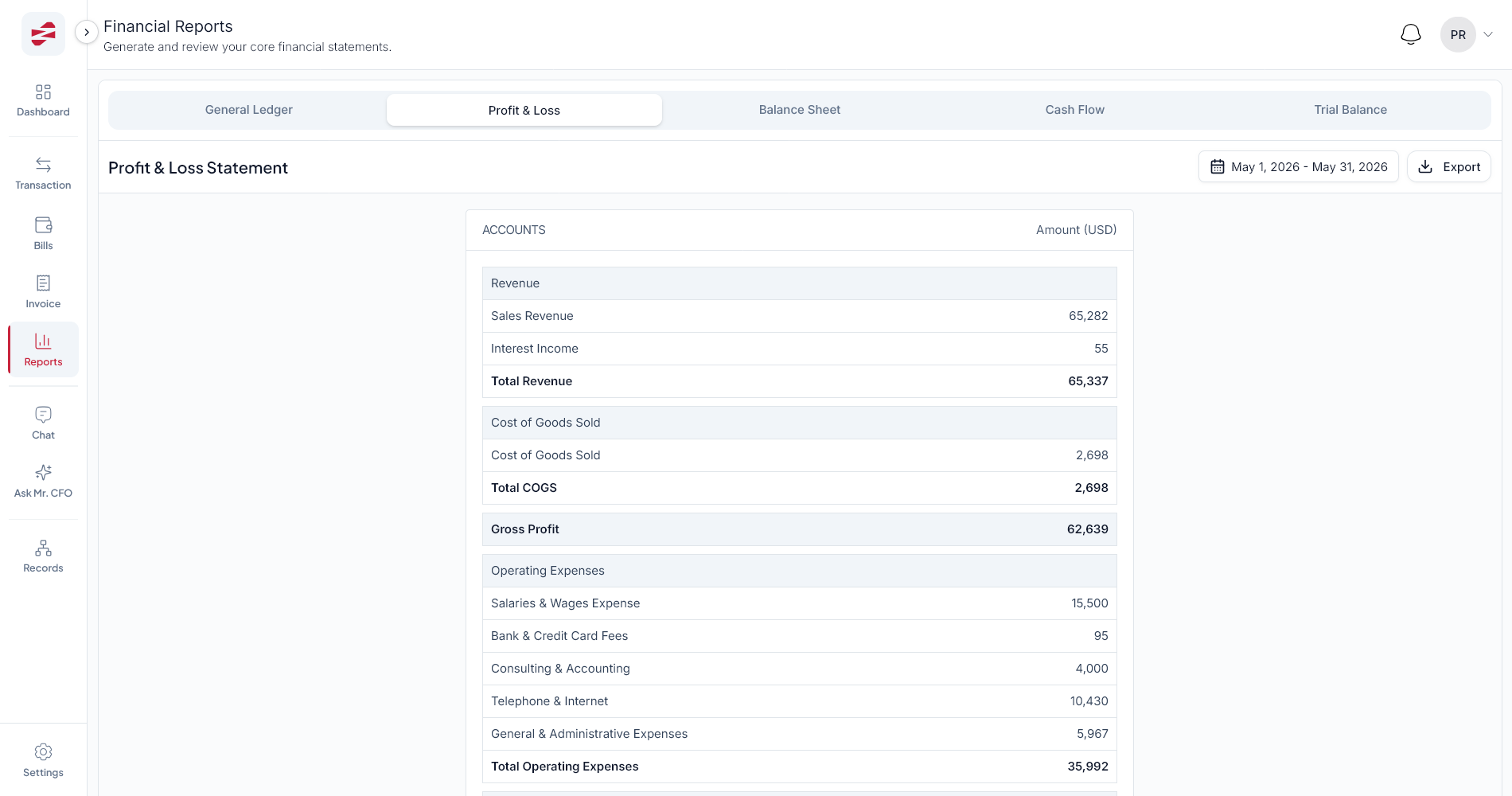
A profit and loss statement, a balance sheet and a trial balance for the period, prepared under the standard that applies to your revenue.
- 9
Hand over to your tax agent
Give your accountant or registered tax agent the statements, the trial balance and the supporting documents. They prepare and file the return.
- 10
Archive for 7 years
Keep the books and documents, in English or Arabic, where you can produce them if the FTA asks. The FTA can ask for an Arabic translation of English records.
Documents to have on file for each tax period
- Bank statements for every account, every month
- Sales invoices and credit notes
- Supplier bills and receipts
- Payroll and end-of-service gratuity records
- Fixed asset purchases and disposals
- Loan, lease and shareholder agreements
- Trial balance and financial statements
- Your SBR election and revenue workings, if you claim it
What if your books are months or years behind?
Catch up before the filing deadline, starting with the earliest period you have to file for. The slowest part is turning old bank statements and spreadsheets into journal entries; the second slowest is checking them.
ZeroFin's historical rebuild is built for this. On the Growth plan ($25 a month, about AED 92, billed in US dollars) and above, you upload bank statements or ledger exports as PDF, Excel (.xlsx) or CSV files of up to 25 MB. ZeroFin's AI drafts balanced journal entries into a separate review area, and you check and approve them before anything posts to your books. You can then run the profit and loss statement, balance sheet, cash flow statement and trial balance, and keep the books in AED.
What ZeroFin does not do
ZeroFin doesn't calculate Corporate Tax, prepare or file tax returns, or act as a tax agent. It isn't on the FTA's tax accounting software register and isn't an accredited e-invoicing provider. It also doesn't check imported statements against the bank's closing balances, so confirm each month-end balance yourself before handing the books to your tax agent.
Which other deadlines should be on your radar?
Corporate Tax isn't the only change. Under the UAE e-invoicing programme, businesses with revenue under AED 50 million must appoint an accredited e-invoicing service provider by 31 March 2027 and start issuing e-invoices by 1 July 2027; larger businesses go live from 1 January 2027 (Ministry of Finance). Clean, current books make both changes easier.
If you're a startup, the same books also answer the questions investors ask. See our startup runway calculator, how to turn bank statement PDFs into journal entries, and what ZeroFin does in the UAE and Saudi Arabia.
This article explains the rules in general terms and isn't tax advice. Check your own position with a registered tax agent.
Frequently asked questions
What is the UAE Corporate Tax rate for small businesses?
0% on taxable income up to AED 375,000 and 9% on taxable income above that. Businesses with revenue of AED 3 million or less in the current and every previous tax period can elect Small Business Relief, which treats them as having no taxable income, for tax periods ending on or before 31 December 2029.
When is the UAE Corporate Tax return due?
Within 9 months of the end of the tax period, and any tax is payable by the same date. For a financial year ending 31 December 2025, the deadline was 30 September 2026; for a year ending 31 December 2026, it is 30 September 2027.
Do I still need to file if I claim Small Business Relief?
Yes. You must be registered, file a Corporate Tax return within 9 months of each period end, elect Small Business Relief in that return and keep records that prove your revenue stayed within AED 3 million. Electing the relief lets you file a simplified return.
How long must I keep records for UAE Corporate Tax?
Seven years after the end of the tax period they relate to, under Article 56 of the Corporate Tax Law. Failing to keep the required records can lead to a penalty of AED 10,000, or AED 20,000 if repeated within 24 months.
Can a small business use cash-basis accounting for UAE Corporate Tax?
Yes, if its revenue does not exceed AED 3 million (Ministerial Decision 114 of 2023). Businesses with revenue up to AED 50 million can use IFRS for SMEs; above that, full IFRS applies.
Does ZeroFin file my Corporate Tax return?
No. ZeroFin helps you build and keep accurate books and financial reports. It does not calculate Corporate Tax, file returns or act as a tax agent. Give your books to your accountant or registered tax agent for the return.
From messy books to CFO-level clarity
Book a free 20-minute Financial Clarity Diagnosis and see what trusted books look like for your business.
Book a Financial Clarity Diagnosis